Crete birding
Updated: Feb 18
I often visit the Island of Crete during bird migration, it's a great place for wildlife photography. In April the White Mountains (Lefka Ori) remain covered in a blanket of snow as flowers in bloom bring vivid colour to the landscape and the scent of Orange blossom fills the air. In contrast September brings the aroma of wild herbs which grow in swathes around the Carob trees and Olive groves. Crete, the largest of all the Greek Islands varies dramatically end to end, with outstanding beaches, breathtaking mountains and impressive gorges all impacted by the changing seasons and perfect for the Islands wildlife. I first came to Crete over 40 years ago and have returned many times since, here are a few of my favourite birding spots and images from this beautiful and diverse Greek Island. Honey buzzard at Lake Agia.

Lake Agia.

Located 10 km West of Chania and recognised as one of Crete's premier birding locations Lake Agia boasts over 200 species, including migratory birds like the Purple heron, Baillon's crake, and various Falcons. A walking path encircles much of the lake offering views of Lefka Ori along with diverse flora and fauna. Visit in spring or autumn to observe the many migratory birds. Early morning or just before sunset are the best times to capture wildlife activity.
Below: Baillon's crake.

Akrotiri Peninsular.

Birding on the Peninsular at Akrotiri, near Chania, is an excellent location for spotting both migratory birds and resident species. Key sites include Souda bay, Gouverneto monasteries and the abandoned Katholiko monastery in Avlaki Gorge along with the rocky coastlines for raptors. Best in spring and autumn the peninsular is mainly dry with key areas of wetland and small hidden pools. Avlaki Gorge is highly recommended for both scenery and birding.
Below: Bee-eater.

Kladissos beach.

The area behind the beach and surrounding scrub is a great place to spend a few hours birding and is located 2 km west of Chania. Near the end of the beach an inlet bringing water from the mountains is a good spot for migratory birds, dry in summer but in early spring is a hive of activity as Swallows collect mud for their nests and waders forage in the shallow waters. The surrounding dunes, reedbeds and Coastal scrub are a haven for a variety of birds.
Below: Woodchat shrike.

Aradina Gorge.

Birding from Aradena Bridge in the South West of Crete offers spectacular dramatic views along with the opportunity to spot high-altitude raptors and rocky-habitat bird species, particularly around the 138-meter-high bridge. This area is known for its steep, rugged terrain and deep narrow gorge, which creates a quiet environment filled with the sound of bird call and foraging goats. Hiking through the Gorge towards Marmara beach is also worth trying.
Below: Bonelli's eagle.

Lefka Ora (White Mountains).

Birding here can be very productive particularly for raptors, mountain species and endemics within the dramatic limestone landscape. Key species here are Bearded vulture, Golden eagle, Griffon vulture and Red-billed Chough. Designated an Important Bird Area (IBA) and a UNESCO Biosphere reserve with locations such as Samaria Gorge, Ormalos Plateau and Greleskas Observatory. Spring/Autumn is best while Summer allows access to the highest peaks.
Below: Red-billed chough.

Pressano Gorge.

A great spot for viewing Griffon Vultures, Falcons and Eagles. The Gorge with it's high rocks provides the ideal nesting habitats for these species. A trek through the Gorge is considered to be challenging but views from the top can be productive by taking the road off Rethimnou-Prasion which is signed Belvedere villas. The road turns into a track which can be accessed year-round unlike the Gorge which is only accessible during the Summer months.
Below: Black kite.

Potami Dam.
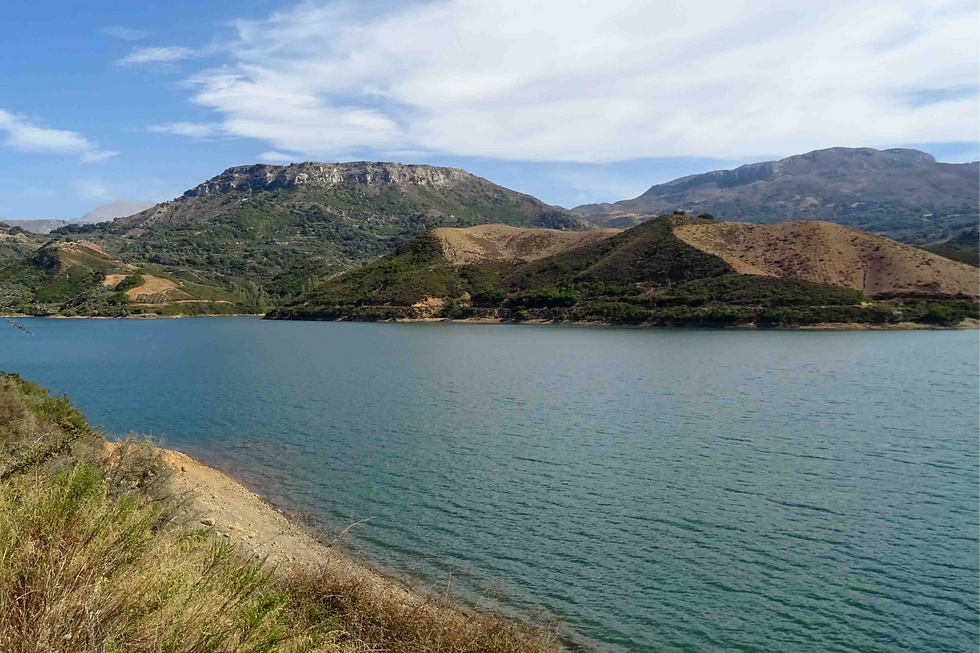
The reservoir located 25 km South of Rethymnon in the Amari Valley is a popular birdwatching spot. Completed in 2008 this large artificial lake has now become an important wetland habitat attracting a diverse range of waterbirds, raptors, and migratory species including the threatened Ferruginous duck. Spring and Autumn are the best time of the year to visit while some of the Islands wintering waterfowl can be found here during the later months.
Below: Ferruginous duck.

Psiloritis Mountains.

These mountains are home to Bearded and Griffon vultures along with a variety of Eagles, Falcons and Buzzards while other mountain specialists include Alpine chough, Red-billed chough, Rock partridge and Blue rock thrush. Mount Ida, the tallest peak on Crete has a road leading to the Mygero Refuge area which makes it easily accessible. From here you can ascend the mountains on foot or stay around the car park area and explore the Nida plateau.
Below: Alpine chough.

Elounda.

Attracting migratory and resident bird species near Kalydon Island with a variety of habitats including Salt pans, Olive groves and a Coastal promontory. Common birds found in Elounda are Red-backed shrike, Sardinian warbler, Willow warbler, Spotted flycatcher and Waders such as Curlew Sandpiper, Little Stint, Little ringed plover, Ringed plover and Temminck's stint. Over the bridge at the Christian basilica and Chapel of St. Luke can be productive.
Below: Red-breasted flycatcher.

Vrouhas and Selles.

Above Plaka at the Spinalonga viewpoint, Griffon vultures regularly circle above the rock face along with Eleonora's falcon, Kestrel, Swallow and Swift. Blue rock thrush, Warblers, Shrikes and Wheatears can also be found here while through Vrouhas the monastery of Agios Ioannis Prodromos and all the surrounding Olive groves are usually productive. Through Selles a raptor viewpoint at Pano Loumas offers great panoramic views down to the Coast.
Below: Wryneck.

Lasithi Plateau.

The diverse landscape at Lasithi is ideal for birding, fertile orchards, groves and arable land beneath the Dikti mountains provide a variety of habitats for Passerine's and raptors including Eleonora's falcon, Golden eagle, Golden oriole, Bee-eater, Woodlark, Common quail and Chukar. Flycatchers, Warblers, Pipits, Wheatears, Shrikes and Buntings can also be found here. Prime spots are around the lakes which attract large numbers of hirundines and waterfowl.
Below: Golden eagle.

Aposelemis Dam.

A popular location for birding attracting a variety of species including migrating and breeding birds like the Griffon vulture, Black kite, Golden eagle and Eleonora's falcon. Hirundines, Swifts, Herons, Cormorant, Wading birds and Waterfowl can also be found here along a variety of Buzzards. Viewing is best by following a track past the old abandoned village of Sfendili which may be visible depending on the water level. The track stops at the Dam wall.
Below: Eleonora's falcon.

Asterousia Mountains.

An excellent location for birdwatching particularly good for observing birds of prey. The mountains are home to a variety of species including Bearded and Griffon vulture, Golden eagle, Bonelli's eagle and Peregrine falcon. The area also attracts a large number of migratory bird species. The mountains are part of the European Protected Areas Network (Natura 2000) emphasising the importance of the conservation efforts undertaken in this area.
Below: Griffon vulture.

Damania reservoir.

Damania Dam is a relatively new and small wetland located in the Archanes-Asterousia municipality of the Heraklion prefecture and has emerged into a significant location for birdwatching in the region. Particularly good for observing wetland-dependent and migratory birds as it retains water throughout the year. The area consists of a dam, surrounding reedbed and agricultural land providing a haven for a variety of bird species, accessible all year-round.
Below: Black-necked grebe.

Abas Gorge.

A prime location for observing the Islands birds of prey. Steep cliffs and a diverse habitat supporting a variety of raptors including Lammergeier, Griffon vultures, Peregrine falcon and Lanner falcon. The Gorge is known for its impressive 140 m waterfall and its unique location between the Monopori and Kefala peaks, ending at Tris Eklisies beach. Other birds found here include Woodlark, Crag martin, Swallow, Swifts and Blue rock thrush.
Below: Crag martin.

Bramiana reservoir.

Bramiana reservoir is located northeast of Ierapetra in the southeast of Crete, and is a premier birding wetland, particularly during Spring and Autumn. This protected, shallow reservoir boasts over 218 recorded species and acts as a crucial stopover for migrants including rare waders, ducks, herons and raptors like the Booted eagle. Autumn is excellent for shorebirds due to low water while in Winter the high water attract many Coots, Teal and Gulls.
Below: Booted eagle.

Gallery:


Mình xem xổ số miền Bắc cũng được một thời gian, chủ yếu để thư giãn và thử chút may mắn cho vui. Hồi đầu toàn chọn số theo linh cảm, thấy số nào thuận mắt là ghi, nhưng càng về sau mình thấy theo dõi thống kê vẫn giúp mình bớt cảm tính hơn. Thỉnh thoảng mình còn để ý riêng XSMB thứ 3, vì có những đợt nhịp ra số nhìn khá hay, đôi khi lại trùng với vài con mình từng chú ý từ trước. Dù vậy mình luôn tự nhắc là xem giải trí thôi, chứ đặt kỳ vọng nhiều quá thì dễ thất vọng. Mình cũng hay ghi lại vài cặp số lặp lại để…