Suffolk Birding - April 2026
Updated: Jul 26
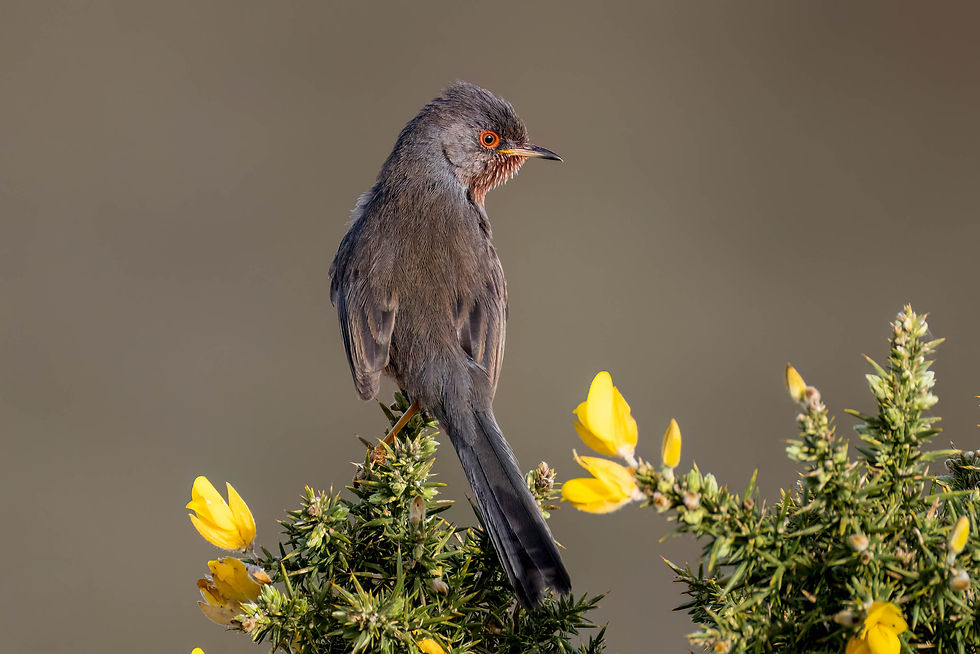
A male Dartford warbler perches on top of bright yellow gorse and begins to sing, its early morning in April, there's something special about birding in Suffolk during this time of the year, the heathlands are awash with a mosaic of vivid colours and birds take advantage of the additional food source this brings, making it a great time for wildlife. Breeding season is well underway and Suffolk becomes a hive of activity as summer visitors arrive and begin to hold territory, Bitterns are booming, Avocets are displaying and Hirundines fill the skies. This is undoubtedly one of the best months of the year for birding. Dartford warbler on top of gorse.
Westleton Heath.
On Westleton Heath we had some fantastic views of Dartford warblers over the three days of our birding trip recording at least 8 individual singing males who were particularly active during the early morning sunshine and was regularly observed holding territory and singing from the gorse. We only covered a relatively small area of the heath each visit which included both sides of Dunwich road. Dartford warbler.
This year was also a particularly good one for Nightingales with more than a dozen heard singing over a three day period, the highest concentration being at Westleton where at least nine individuals were heard singing during the course of our visits. The number of breeding pairs have increased over the last few years in Suffolk and this is a great place to see and hear this song bird which can prove difficult to locate. Nightingale.
Other sightings were Skylark, Woodlark, Linnet, Meadow pipit, Curlew, Stone curlew, Chiffchaff, Blackcap, Red-legged partridge, Shelduck, Carrion crow, Raven, Jackdaw, Magpie, Bullfinch, Herring gull, Robin, Rook, Starling, Common whitethroat, Chaffinch, Great tit, Blue tit, Goldfinch, Blackbird, Wren, Kestrel, Great spotted woodpecker, Green woodpecker, Sand martin, Common buzzard, Greenfinch, Mistle thrush, Dunnock, Jay, Stonechat and Whinchat along with Rabbit, Muntjac deer, Slow worm and a black Adder.
Chiffchaff
RSPB Minsmere
Sand martins had arrived back in numbers and were busy nesting in the banking near the visitors centre, at the north hide Nightingale, Blackcap and Chiffchaff were singing, from the hide we recorded Barnacle geese, Oystercatcher, Lapwing, Shelduck, Gadwall, Greylag geese, Mute swans, Avocet and teal. Along the north wall we noted Reed bunting, Cetti's warbler, Sedge warbler and Bearded reedling while from the east hide we had views of Lesser Black-backed gull, White wagtail, Black-headed gull, Herring gull, Shoveler, Canada geese, Mallard, Egyptian geese, Moorhen, Coot and a Bittern could be heard booming from the reedbeds.
Egyptian goose
Continuing on along the beach we had Mediterranean gull and Sandwich terns passing over with the other gulls and dropping in at the public viewpoint we had views of both species along with sightings of Dunlin, Turnstone, Little egret, Cormorant, Wigeon, Common tern, Barn swallows and house martins were flying overhead. From the sluice we noted Ring ouzel and from the south hide, Tufted duck, Great crested grebe, Little grebe and Lapwing. A Marsh harrier passed over lifting the Gulls, Lapwings and Avocets as we entered the wildlife lookout hide where we had some great views of them returning to the surrounding scrape.
Mediterranean gull
We returned back in the late afternoon and walked the woodland towards the Bittern hide where we spotted Long-tailed tit, Whitethroat, Great tit, Blue tit, Siskin, Redpoll, Great spotted woodpecker, Blackcap, Wren, Robin, Dunnock, Stonechat, Magpie, Jackdaw, Rook, Blackbird, Wood pigeon, Carrion crow and Starling. At the Bittern hide we spotted Great white egret, Little egret and Grey heron, Bittern were booming but only spotted at some distance while Marsh harriers patrolled the reedbed close to the hide. Continuing on to the Island mere hide we had better views of several Bittern and also noted a male Sparrowhawk and Pochard, returning through the woodland we had views of a nesting Treecreeper and an encounter with a Muntjac.
Bittern
Walberswick
We headed over to Walberswick to try and catch up with the long-staying Zitting cisticola which have taken residence between the beach and Dunwich river. The unsettled and windy weather dint help and the birds were a no show, other sightings here included a Kestrel observed catching and dispatching a lizard, Northern wheatear just arrived and still on the beach, Meadow pipit, Barn swallow and a large flock of House sparrow.
Kestrel
Vault hill
Arriving both early morning and late evening we had several distant sightings of Stone curlews along with, Pheasant, Common buzzard, Red kite, Kestrel, Jackdaw, Rook, Raven, Carrion crow, Magpie, Stonechat, Wren, Green woodpecker, Northern wheatear, Blackcap, Common whitethroat, Skylark and Marsh harrier. The following morning we were alerted to an Iberian Chiffchaff, a rare vagrant which had turned up back at Westleton heath, we stopped off on our way back home and not long after had some great views of the bird in the trees surrounded by Blackcaps , Chaffinch and regular Chiffchaffs but easily identified by its song.
Red kite
Other sightings
Muntjac deer, Rabbit, Slow worm, Black adder.
Muntjac deer
Video link


Comments